Wednesday, December 14, 2022

RECOMMENDATIONS FOR BUDGET : 2023-2024


Introduction

1. This would be the last full budget of the present Government in its second term. The Finance Minister has recently announced the direction of the Budget for 2023-24 that it will be “carefully structured to sustain growth and contain inflation”. The focus of the budget should continue to be on Capital spending. In the previous year (2022-2023) the Capital expenditure was Rs 7.5 trillion. This year, it should be Rs 10 trillion, in the absence of Private sector investments.

2. India is doing better than the other large economies. However, issues which will be impacting our ‘Gen Next’ who are going to be tomorrow’s workforceneed to be addressed. These are:-

(a) Structural unemployment

(b) Poor state of education

(c) Health care

(d) Nutrition deficits

3. Recommendations of the Think Tank are given in the succeeding paras.

RECOMMENDATIONS

Rationalisation of Expenditure

4. There is an imperative need to identify and cut non priority spending to meet the fiscal deficit target of 6.4% of Gross Domestic Product (GDP) and remove inefficiencies in expenditure. Need to reduce leaks especially in flagship schemes like MGNREGA. The usage of Single Nodal Agency (SNA) dashboard is an effective usage of technology to monitor & reduce avoidable expenditures. Through the SNA dashboard, officials can track usage of funds from the Central treasury to Ministries, State treasuries and departments and down to vendors, contractors or implementing agencies. It is expected that SNA dashboard could save as much as Rs. 40000 – 50000 crore.

Fiscal Deficit

5. The plan for the fiscal deficit is to bring it below 4.5%. of GDP by 2025-26 from the target of 6.4% for 2022-23. To achieve the target of 2025-26 as part of fiscal discipline, budget should target it to less than 6% of GDP. The govt. should rationalize subsidies on food, fertilizer and fuel.

Inflation Management

6. The inflation target till March 31, 2026 has been kept at 4% with a margin of 2% on either side. Monetary Policy should not be synchronised with developed world counterparts. Government must put in place a mechanism where Centre and States work in synergy to tackle price rise.

Global Recession

7. A synchronised increase in Global interest rates has led to the risk of a Global Recession. Indian economy however is on a strong footing to withstand any turbulence. Even if a recession hits domestic shores, India is likely to have a softer landing. Indian economy is greatly decoupled from Global economy due to its large domestic demand and adequate Forex Reserves.

Small Savings Rates and Inflation

8. Negative returns have serious consequences for the economy if households, which are the highest lenders, stop parking their savings in such fixed income instruments. Returns on Small Savings should be positive. Savings rate should be high enough to incentivise savings and low enough for higher credit off take and consequent higher growth. 

Job Creation

9. Government has to adopt the role of a principal employment generator. The remedy to overcome job shortage is to raise public investment that can boost growth enabling the private sector to hire more people in helping income grow and spur consumption, raising capital expenditure and improving the quality of education and skills.

10. Govt must create jobs through MGNREGA in Urban areas through a dedicated scheme involving private sector and in Rural areas through theme-based schemes. A mechanism needs to be devised to share expenditure between Centre and States in the ratio of say 60:40. Social security mechanism may be considered for Gig economy.

Monitoring of Capital Projects

11. Progress of on going 1500 infrastructure projects worth Rs 26 Lac crore require a constant monitoring. States need to be incentivise to invest on infrastructure projects including clean infrastructure. Front loading of infrastructure projects should continue.

Institutionalized Think Tank Concept

12. States should be encouraged to institutionalise concept of Think Tanks. It will supplement the State cabinet’s work as ministers are usually too occupied with their daily work. This will enhance the success rate of projects. 

Private Investment

13. Private investment accounts for close to 75% of total capital formation in the economy. Its revival therefore is essential for sustained growth of the economy. Till its revival, public investment can play the role of an engine of growth for Indian economy. The expansion in public investment may have to be sustained for a sufficiently longer period.

14. Creative non fiscal instruments must be introduced to increase private investment into infrastructure on annuity/hybrid basis in sectors other than highways namely for construction and maintenance of worker’s dormitories; sewage treatment, providing running and maintenance of public transport. Use Govt procurement to get private investment with higher domestic value addition in key areas such as solar panel production etc.

Reinvent the Working of Economic Division

15. Due to Digital India, lot of data is available which at presently is not being used effectively. Behavioral economics aspect is neglected at present regarding how the potential consumers will respond. An illustration is that the Government continues to tax individuals only on the basis of income but without reference to how the expenditure patterns of those individuals have changed. Today around 80 per cent of income is spent on various fixed expenses vis-à-vis 55 per cent in the past leading to drop in household savings rate. Hence ideas of “old economists” still continue to impact growth, which needs to be relooked at.

Indo Pacific Economic Forum

16. India has not joined the trade pillar of the U.S.A.-led Indo-Pacific Economic Forum. The move not to join the trade pillar mirrors India’s decision to walk out from the Regional Comprehensive Economic Partnership (RCEP) which was China-led. If India has to achieve the goal of USD 5 trillion economy and subsequently an advanced economy by 2047, it has to be Globally competitive from which it cannot fully isolate itself from Global economy.

MGNREGA – Finetuning

17. To make it more effective and relevant the following is required:

(a) Diversification : There should be greater diversification of permissible works.

(b) Fund Management : In the past few years, Fund Management has been centralised instead of paying the Gram Sabhas. The Gram Sabhas can take into account the local conditions and Community’s requirement.

(c) Revolving Fund : Need to have the Concept of a Revolving Fund that can be utilised.

(d) Low Wages : Wages are far below the market rate in many states, defeating the purpose of acting as a safety net.

Production Linked Incentive (PLI) Scheme

18. The PLI scheme should be extended to different sectors namely Leather, Bicycle, Vaccine materials, Telecom products, Toys, Chemicals and Shipping containers.

19. The Concept of PLI should be extended to services sectors in the form of Employment Linked Incentives (ELI) schemes. To start with, ELIs should be introduced in 4 Employment Intensive Services sector with high growth potential in Tourism, Logistics, Retail and Film Animation and Gaming. Also PLI for Electrolysers may be considered to help India’s vision of producing 5 million tonnes of Green Hydrogen by 2030. Need to integrate PLI with Foreign Trade Policy and FTAs.

Exports

20. The govt. must make a road map to achieve exports in Global trade to 3% by 2027 and 10% by 2047 from the current 2.1%.To promote 100 Indian brands as Global champions we need to follow steps as enumerated below:-

(a) Have a system to provide Import Export Clearances within one hour of arrival at entry points and custom ports.

(b) Set up the Economic Zones outside India as an extension of the Atma Nirbhar Bharat initiative.

(c) Focus sectors could be interalia, Pharmaceuticals, Gems & Jewellery, Marine & Agriculture, Textiles & Leather, Engineering Goods, Electronics and Telecom products, Chemicals, Tourism, IT & ITes, Business services, Financial services, Healthcare & Wellness, Education and Services,

(d) Enhance participation of MSMEs

(e) 200% tax deduction on the expenditure made by exporters for overseas marketing.

(f) Reduce customs duties on raw silk, silk yarn, raw cotton and copper ores.

(g) Promote export based imports at a lower rate of customs duty.

(h) Involve embassies abroad to identify new products & markets.

(j) Single Window Export Clearance. To reduce logistics costs, there is a need to integrate Customs Network with various regulatory agencies for expeditious clearances of export consignments on the same lines as imports.

(k) Services Exports. It is much easier to increase services exports than manufacturing in the current Global environment. Further Service sector jobs are more labour intensive, which would help create more jobs. Promote branding of services exports on the lines of manufacturing sector like “SERVICES FROM INDIA”, “SERVICES IN INDIA”.

(l) Developing Districts as Export Hubs. States need to be engaged actively in Export Promotion activities; Convert each district into an Export Hub. Also, States should be made partners in monetary benefits arising out of exports.

Autonomous Trade Body / DESH / SEZ Act

21. Set up a Trade Body as an autonomous organisation under Commerce Ministry on lines of Investment India. Further, the upcoming Foreign Trade Policy, to be announced in April 2023, should cover E-commerce exports. Also, the new SEZ Act titled as Development of Enterprises and Services Hub (DESH) which will replace the existing SEZ Act 2005 should be futuristic, liberal and exports-friendly.

Internationalise Rupee

22. There is a need to further promote the possibilities to settle International Trade in the local currency beyond Russia & Iran. This will push the RBI’s move to Internationalise the rupee. 

Rupee Depreciation

23. The Rupee has depreciated more than 8% against the Dollar so far in 2022. Rupee’s Real Effective Exchange Rate (REER) signals that the Indian currency is still overvalued. However, it needs to be ensured that REER does not appreciate, since it will have a negative impact on domestic value addition and job creation.

Free Trade Agreement (FTA)

24. While firming up of the FTAs & EHAs with major trading partners. It needs to be ensured that FTAs and/or Early Harvest Agreements do not result in adverse developments for India especially through an inverted duty structure. Also revisit the customs duty structure to make Indian industry, Globally competitive.

Climate Action Plan

25. COP-27

(a) India is among the top 7 emitters of global greenhouse gases (GHG). The 7 emitters are: China; EU27; India; Indonesia; Brazil; Russia and USA.

(b) India has set a target of net zero emissions by 2070. Need to have a road map for net zero and its funding agenda.

(c) Developing countries need to ensure that under Loss and Damage fund, developed Countries are held morally responsible and financially liable for their contribution.

G-20 – AGENDA

26. India has assumed the Presidency of G-20. It must set the ball rolling to reform the G20, set new limits on Economic Warfare, leveraging a new architecture on Global Supply Chains, reshape the Global Green Agenda and prevent debt related crisis. Following could be the issues for discussions:-

(a) Global Supply Chains. Countries need to work together to develop policies relating to supply chains.

(b) Economic Sanctions. Countries are using economic sanctions as a tool of modern war. Frame rules that should govern the use of “economic sanctions” as weapons henceforth.

(c) Green Energy. Developed countries must come forward to finance the transition needs of the developing countries.

(d) Other Issues

(i) Expedite the extradition of fugitives to enable them to face criminal justice system of        India

(ii) Locate wanted persons (Red Alert)

(iii) Enhancement of criminal intelligence sharing, terror financing and online radicalisation

(iv) Financial sector regulation

(v) Infrastructure investment

State Finances

27. Some states are taking loans secured against assets like municipal parks, collector’s office, taluk office, courts, hospitals, etc. These are entities which do not have revenue streams to service loans they are getting based on State Government guarantee and/or security of land or escrow of state revenue. States need to stop this practice and plug revenue deficit by increasing Property Tax, Excise duty on Liquor, fee for Govt services in line with inflation and growth. Reduce/replace inefficient subsidies and freebies. Rationalise autonomous bodies and schemes.

28. Central government should merge the cesses and surcharges into the basic rates tax of GST so that States receive higher share in the divisible pool of taxes.

Freebies Economy

29. There is an immediate need to put a brake on reckless promises that cannot be fulfilled without any thought to fiscal prudence. Disinvestment

30. Government has set a target to raise Rs 65000/- crores from disinvestment during the financial year 2022-23. So far, it has been able to raise around Rs 24500/- crore due to a combination of reasons. Need to involve consultancy organisations to achieve the stipulated goal.

31. Govt should consider various models of disinvestment especially in the case of Hospitality industry. The property can be leased on operation, management and development basis without transferring the ownership of the same.

National Monetisation Pipeline 

32. The Ministries of Power; Civil Aviation; Railways; Oil and Gas are likely to miss the target. To incentivize the Ministries to meet the target, link the budgetary Support to ministries’ to monetization, also ministries may be asked to identify additional asset classes. Also States should identify assets to monetize namely State highways and expressways transmission network, urban terminals, State Warehouses and others.

MSP Panel

33. GST Council model may be replicated for firming up MSP. Farm groups need to shed their uncompromising attitude and come together to urgently discuss, deliberate and negotiate with the government with an open mind. This is the only way forward to resolve differences and avoid disruptions.

34. There is a need to focus on the agriculture and farm sector with enhanced budget and also to focus on rural infrastructure, investment’s in Supply Chain, technology, crop diversification and matters concerning climate crisis.

Krishi Gati Shakti

35. Secondary agriculture is of primary importance. Need to promote secondary agriculture to reduce wastage; generate employment and enhance farmers’ income. Hubs for secondary agriculture in cottage and village industry sector should be encouraged. Involve Gram Panchayat; establish facilitation centres; have comprehensive ecosystem from origin to conclusion i.e. production to marketing.

36. National policy for rainfed farming needs to be announced to have optimum utilization of scare water resources. Also micro-irrigation system should be encouraged in a systematic manner by incentivising the usage of the same.

Farmers Producer Organisation

37. Promoting women-led FPOs is crucial for the rural economy and ensuring inclusive growth and empowering women. Policy support in terms of easy availability of finance; increasing digital literacy; CSR funding by corporate; customize technologies for women farmers and others.

38. Income Tax exemption to FPOs should be extended by 5 years which will be ending on 31st March 2023.

Labour Codes

39. All the 4 Codes – the Code on Wages; on Industrial Relations; on Occupational Safety, Health and Working conditions and on Social Security need to be introduced in one go. Central government has to impress upon the remaining States/UTs to frame the rules fast. Central trade unions should be consulted & taken on board for firming up the rules for the Labour Codes.

40. Railway Reforms

(a) Corporatize Railways and outsource its support services.

(b) Digitisation of Railway records to enhance efficiency.

(c) Revisit the Model Concession Agreement terms to attract private sector participation;

(d) Reduce the dependence on gross budgetary support or borrowings from the Central govt.

(e) Advance the target of moving towards achieving Net zero carbon Emission by 2030.

(f) Expedite the replacement target of steel rake with Aluminium freight rake.

(g) Encourage corporates to use railways instead of road transport. Introduce the system of rail green points.

(h) Explore the possibility of clubbing real estate monetization with redevelopment of railway stations.

(j) Consider merger of six existing companies to ensure efficiency for development projects viz:-

(i) Railways Vikas Nigam LTD.

(ii) Indian Railways Construction LTD.

(iii) RailTel Corporation.

(iv) Indian Railways Catering and Tourism Corporation.

(v) Braithwaite and Co Ltd.

(vi) Rail India Technical and Economic Services.

(k) Merge specialised funds operated by Railways to enhance allocation of funds for development projects.

(l) Need to sweeten the Public Private Partnership (PPP) mode for modernization of railways. Explore the possibility of clubbing real estate monetization with redevelopment of railway stations.

(m) Railways should announce a Roadmap to start export of indigenously manufactured Vande Bharat Trains.

Education Policy

41. New Education Policy and other national policies suggest that our investment on Education should be at least 6% of our GDP. At present it is around 3% of our GDP. This only reflects that as a country, we need to spend more on our learning and education system. Also we need to move towards a Digital Education System. In view of the paucity of funds, we should encourage participation of our private sector.


Health Sector

42. India’s public expenditure on healthcare is only 2.1% of GDP while Japan, Canada and France spend about 10% of their GDP on public healthcare. Even neighbouring countries like Bangladesh and Pakistan have over 3% of their GDP going towards Public Healthcare systems. Government should encourage private hospitals as they make a significant contribution to our Healthcare programmes. Target should be to make available small hospitals within a radius of 10 km.

43. Also need to focus on Tele-Medicine facility, manufacturing of “off-patent” medicines, Pharma Park. 

Malnutrition – Year of Millets (2023)

44. As per the latest report, 35.5% of our children below the age of 5 years, were stunted, 19.3% showed wasting and 32:1% were underweight. Food rations through PDS and special supplements are essential. Greater involvement of local government and local community groups in the design and delivery of tailored nutrition interventions is a must. On the initiative of India, the UN will celebrate 2023 as the International year of Millets. It is an economical & nutritious food which will help us to overcome malnutrition issue. There is a need to promote its production and consumption.

Bio Fuel 

45. At present 10% of our Petrol has an ethanol mix. The aim is to achieve a 20% mix by 2025.

46. The current edition of the National Policy on Biofuels – 2018 needs to promote setting up of Second – Generation (2G) bio refineries. Also Ethanol technologies must be developed and commercialised. Need for a viability gap funding scheme for 2G Ethanol Bio refineries. Our current ethanol production capacity is around 800 crore litres & this would need to grow to 1016 crores litres by 2025.

GST on Petrol and Diesel

47. Petrol and Diesel have been kept outside the purview of the GST regime and is taxed both by the Union and State Governments. If all the petroleum products are brought under the purview of the GST, Petrol and Diesel will have uniform rates across the Country. This will ensure that fuel taxation will also become transparent for the general public. On a purchase of Petrol of Rs 500, a buyer contributes tentatively Rs 300 to the exchequer.

48. GST Refunds. A GST Appellate Tribunal National Authority & Advance Ruling be set up to mitigate problems taxpayers are facing in filing appeals with High Courts especially for rejection of refunds. 

Ease of Doing Business

49. (a) Decriminalise Taxation Laws. As part of Ease ofDoing Business, steps should be taken to decriminalise taxation laws, remove provisions in the Income tax, Goods and Services Tax and Customs Laws that are similar to sections that can be invoked under the Indian Penal Code (IPC). Increase the thresholds for declaring a particular act as a crime. Further various sections under income tax act should have time limit to complete the transaction.

(b) Allow smooth exit for loss making companies and have faster dispute resolution mechanism.

(c) Concept of Digital certification should be introduced through digital locker say for environment certificate etc.

Ease of Filing I.T. Return

50. At present, taxpayers are required to furnish their income tax returns in ITR1 to ITR7 depending upon the category of person and nature of income. Have a common ITR by merging all the existing returns of income to the extent it is feasible.

Capital Gains Tax-Rationalisation

51. To make Capital gains tax structure simple and tax-payer friendly and reduce compliance burden bring parity between similar asset clauses and revise the base year for computing indexation benefit to make it more relevant.

Corporate Tax Rates

52. The status quo of corporate tax rates should be maintained. However, concessions, incentives and benefits could be phased out in a calibrated manner.

Personal Income Tax

53. To revive consumption demand, need to reduce personal income tax rates to increase households spending power. 

Legal Reforms

54. One of the Panchpran (five pledges) pertains to removal of any traces of a colonial mindset. However, we still have on our books British era laws that contain regressive and unadulteratedly colonial statements. As of today, over 250 Central Acts enacted in pre independence India continue to remain on record. This must change.

CONCLUSION

55. India is likely to become the third biggest economy after US and China by Fiscal Year 28, two years earlier than initially expected, overtaking Germany and Japan.

56. India’s biggest challenge now is to strike a balance between inflation and growth. Though the external conditions are rough at the moment, India is relatively well placed to keep growing at a fast rate. India needs to not only grow significantly faster than its faltering pre pandemic trajectory but also deliver better quality growth that is inclusive and meets the aspirations of millions of its youth who constitute its demographic dividend.

Friday, November 11, 2022

STRENGTHENING INDIAN RAILWAY'S CONTRIBUTION TO THE ECONOMY

INTRODUCTION

Initiatives and Achievements of Indian Railways (IR)

1. Indian Railways be complimented for National Railway Plan (2030) which addresses Network congestion by rapid capacity augmentation of 5,571 Km of very high density network. Prioritization has been done by classifying criticality of projects with a total outlay of Rs 7.5 lakh Cr.

2. Vision 2024 focuses on Port connectivity, coal evacuation, J&K projects and North East connectivity for completion by 2024. 

3. Delhi-Mumbai and Ludhiana- Delhi- Sonnagar Dedicated Freight Corridor (DFC) projects (Total 2800 km), to run long haul goods trains at a speed of 100 kmph potential which is planned for completion by 2023 Construction activities in the high speed Mumbai-Ahmadabad project, held up earlier by land acquisition problems have gathered momentum.

4. Achievement of IR has been on safely with no serious passenger Train Accidents during period 2019-20 - 2020-21 by expediting replacement of over aged assets / track renewals, elimination of unmanned level crossings and replacement of old coaches by new safer Linke Hofmann Busch (LHB) coaches.

CONCERNS AND RECOMMENDATIONS

5. These include recent trends of high operating ratios, low generation of internal net surplus revenues leading to low funding for safety, capital and rehabilitation works. The Parliamentary Standing Committee (2019-20) on Railways also made observations on above concerns.

6. Losses in Passenger Operations. These have mounted to over Rs 50,000 Crs annually. IR needs to address this issue urgently by a progressive increase in fares and seek State & Central Govt support for taking over suburban losses. High Staff costs (60% of working expenses) will need to be reduced by freezing some percentage of vacant posts, progressively.

7. Uncertainties in Future Coal Freight Earnings. Presently these contribute to around 48% of total freight earnings. Demand will come down in future because of carbon emission/climate change issues. Economic Survey (2019-20) has stressed need for IR increasing its share of freight traffic from around 27% to 45% by 2030 in rail/road freight mix from energy conservation/ carbon emission angle. This will be challenging.

8. Financial Performance. 2019-20 ended with Gross Traffic Receipts Rs.1,89,906.58 Cr and Total Working Expenses Rs 1,84,780.30 Cr. The Net Revenue Receipt was only Rs 3,773.86. The Average rate paise/passenger Km was 20.7 in Suburban & 52.4 in Non Suburban.

9. Standing Committee on Railways has revealed a consistent fall in revenues, rising expenditure coupled with erosion of customer base in freight and passenger traffic. There has been increasing dependency on Extra Budgetary Support. Prudence demands of not over reliance on market borrowings. Committee suggested that a part of pensionary payments burden be taken over by Ministry of Finance.

Passenger and Suburban Losses

10. IR is incurring losses over Rs 50,000 Crs annually on passenger/ suburban operations. Survey shows that economic categories can absorb price rises.

11. Suburban Segment. Mumbai Rail Vikas Corporation (MRVC) report states that Mumbai locals have cheapest public transport at 50 paise per km vis Metro at Rs 5 for a km, and BEST at Rs 4/km. There is Considerable scope to increase Suburban fare.

12. Long Distance Passenger Segment. Buses are popular for distances around 250 kms. However, Rail scores over with sleeper facilities and need to adopt dynamic pricing for reserved accommodation for trains like Rajdhani- Delhi- Mumbai. Other Rajdhani's and new fast trains, semi high speed Vande Bharat and special trains run more than 30 per day. There is a need for running some trains with chair cars, especially with upgradation of trunk routes up to 160 kmph. Coaches be fitted with seats with airline type ambience, better designed toilets and heating ovens for food. Platform & travel tickets should include insurance for accidental injuries and ticketless drives must be intensified.

13. Dedicated Freight Corridors. With diversion of Goods trains to DFC from trunk routes, released capacity should be judiciously utilized for new high revenue segments e.g. running of high speed, time tabled, high value parcel trains. To enable pickup and delivery to doorstep, IR should collaborate with cargo couriers/ operators to help in last mile delivery.

14. Special Measures to attract additional Freight to enable IR to reach a share of 45% in Rail / Road Freight Mix. Railways involved in movement of raw materials for steel and large cement plants must focus on greater share of finished steel products and cement and deliver them to specified stockyards or cluster of their warehouses in the region by cooperation with Road Operators. Road transport scores over IR in delivery time. Therefore IR should cut terminal delays and enroute detentions. While Kisan specials have been planned, Milk traffic needs focus with development of refrigerated wagons. IR must effectively integrate into PM Gati Shakti program.

15. Terminal Development. Focus on terminal development especially on PPP mode can help improve efficiency, reduce terminal detention with mechanised handling, providing good road access and locating warehouses near loading points, Railways will have to ensure timely delivery of wagons and withdrawing after loading.

16. Need for Compulsory Shift of Medium Distance Heavy Road Freight Traffic to Railways through Policy Initiatives to progress PM's commitment of Zero Emission India by 2070. Railways consume only 1/6 energy required by road transport. With 100% electrification of IR and progressive increase of Renewable Energy in the National Grid reaching 50% of total mix by 2030, there will be further reduction. in carbon emission if freight traffic from road is shifted to Railways. Govt. will have to hasten the issue of shifting of heavy Road freight to Rail as this cannot be left to market forces. While electric mobility is being encouraged with incentives, bulk of the movement on Highways will still be on fossil fuels for a long time.

17. NITI Aayog, has advocated a Multi Modal approach to transportation covering Railways, Roadways and Waterways. It is understood the European Union is planning greater importance to Rail transportation by higher tolls on road.

NITI Aayog may be entrusted with preparing policy guidelines for Road Rail Freight shift after consulting concerned Ministries, Industry and Road Operators.

18. Planning future Dedicated Freight Corridors Alignment Based on Energy Saving Criteria. In case of Delhi-Howrah, Delhi-Mumbai DFCS, where alignment has been planned adjacent to existing trunk routes, planning for future DFCs be attempted on shortest feasible alignment. NHAI has shortened its Mumbai-Delhi route alignment on this pattern to ensure considerable energy saving. Future DFCs should be planned for 32.5 ton axle load wagon running. New DFC alignment should be connected whenever interchange is required to PM Gati Shakti intermodal points. DFC may also provide adequate land in the central verge to plan rapid transit rail systems to cater for Metropolitan/Tiert cities to reduce overall land costs.

19. Monetization of Assets. There is huge potential of monetizing land at Stations and Railway Colonies in metropolitan cities. Due to complexities involved, there is hardly any visible outcome in policies.

20. Corporatization of Railway Production units - Privatization of Railway of Majority Control in RailTel. Govt needs to hasten Corporatization of Railway Production units to enable them to reach their full potential to serve the needs of economy beyond Railways eg. Defence sector.

21. RailTel PSU. With monopoly in Optic Fibre Cable laying (OFC) IR has completed over 60,000Kms which is nearly entire IR system. It is also providing support to Railways (24X7) in traffic including signaling safety between stations, Anti train collision protection systems (Kavach), traffic control management, radio communication to stations besides add on services. Rail Tel is also involved in providing communication support to many Govt/ PSU units, and organizations involved in National security. For Govt control, disinvestment of RailTel be restricted to 49%.

22. Austerity measures in Revenue Expenditure and Careful Project Selection/Reducing Project costs. Railways need to prune down Revenue expenditure and Project costs. It must explore low cost options like improved signaling by introduction of more Centralized Traffic Control (CTC), Automatic Block Signaling (ABS) prior to planning for additional routes involving land acquisition.

23. Financial interventions for Consideration. When unremunerative projects are undertaken with External Benchmark Rate (EBR), prior approval of Ministry of Finanace (MoF) be taken. Market borrowing bo restricted to 10% to 15% of capital outlay till internal revenue generation situation improves. 

A new model be instituted by MoF to demarcate commercial and social responsibilities of Railways and support funding by Ministry of Railways and Ministry of Finance. 

24. Pricing. There is distorted pricing due to non-revision of fares for Passenger segment. Further, there is loss in suburban traffic with more projects in the pipeline. It is suggested that like the Highways, an act/ rule be contemplated with annual revision of fares linking these to indices like WPI etc. Taking a leaf from the 'Bad Bank' set up by the MoF for bad debts suburban trains system be hived off into an independent entity from financial angle by creation of a special financial structure supported by contributions from Central, State Govts & IR to share losses. Operations to continue with IR.

25. Need For a Full Fledged Railway Regulator. Considering that the PPP model is increasing, there will be need for a full fledged Railway Regulatory mechanism to sort out issues between private operators and IR. With shift of Heavy Freight Road Traffic to Railways, it is desirable for one common regulator for the entire transport sector in future.

26. Building Human Capital in Railways. Keeping in view technological upgradations, it is important Railways pay adequate attention to quality of staff recruited at lower levels. Depending on the competence required, standards similar to Army Recruitment system be implemented. Railways bonus system be restructured for different categories of staff which will lead to overall higher productivity.

27. While restructuring the Railway Board on non departmental lines is welcome, ignoring needs of technical/ professional specialization at lower levels may affect professional performance of the organization. Technical departments be retained below the Apex level of the Railway Board. The Indian Railway Medical Service (IRMS) cadre can be created from Divisional Railway Manager (DRM) and above level consisting of all the general posts like AGM, SDGM/CVO, CPO, CPRO, GM etc

Suggested Focus for IR for - 2030

28. Indian Railways should strive to become low cost, efficient, safe, profitable and zero emission transporter of Passengers & Goods. By integration into PM Gati Shakti program, IR should become the backbone of National multimodal transport network. 


Saturday, November 5, 2022

SURYA FOUNDATION THINK TANK ON INITIATIVES TOWARDS ZERO EMISSION BY - 2070


“The world agrees that lifestyle plays a very important role in climate change. I would like to suggest a one-word movement in the context of climate which can become a key basis for one world. This word is LIFE — Lifestyle for Environment. It can become a mass movement for an environmentally conscious lifestyle.” PM Shri Modi at COP 26, Nov 2021.

INTRODUCTION

1. PM Shri Modi made a commitment of five nectar elements ‘Panchamrit’ at Global Climate Change meet attended by all Global leaders (except Russia & China) at COP 26, Glasgow. India will increase its non-fossil fuel energy capacity to 500 GW by 2030 (increasing from earlier target of 450 GW), with 50% of Energy requirements met from Renewable sources by then. India will reduce its total carbon projection till 2030 by 1 Billion Tonnes (BT). India will lessen its carbon intensity by 45% by 2030 (with respect to 2005 level). India will become a net-(carbon) zero country by 2070. These ‘Panchamrits’ will be an unprecedented contribution of India to climate action.

2. The above commitments, for implementation, will require review of background issues & constraints with some recommendations as under.

GLOBAL WARMING & NEED TO CONTAIN GLOBAL EMISSIONS

3. Green House Gases (GHG) comprising Carbon dioxide, Methane, Nitrous Oxide, gases from Air conditioning plants have property of absorbing infrared radiation being emitted from Earth’s surface and radiating it back to the Earth increasing its temperature. Since beginning of the industrial era, 1.5 degree average temperature rise has nearly taken place and at present rate of emission, 2 degree by 2047 and 3 degree rise by 2100 can be expected.

4. 


The per Capita CO2 emission however was India - 1.77 Tonne (T), compared to USA - 14.24 T, China- 7.41 T, Japan - 8.15 T, Europe- 6.61 T.

5.

6.


Reducing fossil fuel in Power Generation

7. Central Electricity Authority (CEA) in their planning paper (2019/2020) for optimal mix in generation capacity for 2030, had planned for 430,000 MW (280,000 MW Solar+ 140,000 MW Wind+10,000 MW Biomass) Renewable Energy (RE) capacity out of 817,254 MW overall power capacity requirement for India, projected for 2030 (table below). The above CEA RE capacity addition will have to be augmented from 430,000 MW to little beyond 500,000 MW to meet PM’s commitment. Even without above, solar/wind addition comes to 51.41% and adding hydro, nuclear the total comes to 61.8%. The energy contribution from non fossil fuel resources will be around 44% and RE level in capacity slightly beyond 500,000MW will be required. 

8. The target set by PM (500 GW by 2030) capacity level for non fossil fuel, and RE contribution being more than 50% from non fossil fuels, it appears, can be achieved. The average emission factor is likely to reduce to 0.511 kg CO2 / kWh by the year 2029-30 from 0.705 kg / kWh in the year 2017-18 i.e. 29.61% reduction.

Some Constraints to Above

9. Presently the indigenous manufacturing capacity annually for solar cells/ modules is hardly 5000 MW to 7,000 MW capacity. The PLI initiatives announced do not cover full capacity additions against annual requirement of 35,000 MW (including requirements for Green Hydrogen production) to meet target of 2030. Also focus is on small scale production by large no of firms. Hence there is a case for the Govt to invite major FDI, either 100% or in JV with Indian PSUs like BHEL etc. to build ‘Scale” which can bring down costs to meet global competition and facilitate indigenous R&D. This is besides Reliance Jio announcement to enter solar projects/indigenous manufacture of cells in a big way. It is important that Aatma Nirbhar initiatives in solar cell manufacture are hastened to avoid set back to solar program in India.

10. As solar generation is in day only, some Lithium ion Battery storage back up will be called for at mini, regional and national grid levels, adding to costs. China has been cornering strategic reserves of Lithium. Alternatives to Lithium may have to be pursued and India may need to support some R&D with firms globally in this regard. In seeking alternative approaches many feasible solutions should be tried instead of confining to one option. Besides use of more pumped storage Hydel plants, compressed air storage etc may have to be considered to increase mechanical inertia in storage backup. There is also need to bring in a PLI initiative on Power Electronic devices manufacture as Ministry of Electronics focus in PLI has been on Mobiles, Computers, Light electronics/components.

11. Due to the intermittent/ variable nature of renewable power, there is need for introduction of “Smart Grids” from Micro to National Grid level, to allow balancing with base load thermal power, to ensure Power stability. While some small pilot projects are under implementation, the work has to be progressed on priority at full scale level.

12. It is more important for Coal India & the Coal sector/ NTPC to invest substantially in Clean Coal / Carbon Capture, Storage & Utilization (CCSU) technologies in coal based thermal generation to extend use of India’s coal reserves. There is a case for Integrated Combined Cycle plants, generating Power and Syn Gas that can be used for fertilizer/chemical production or in Direct Reduction Steel furnaces. The Govt plans for 100 MT coal gasification with gas grid by 2030 to facilitate small Direct Steel Reduction units is welcome. JSPL has set up a 2.3 MT unit at Angul with coal gasification.

13. Ministry of Power has brought out a good scheme KUSUM for solar pumps, stand alone or grid connected installations for farmers, with centre/ state subsidy & easy credit for balance. The farmers may be given attractive feed in tariff for their surplus power, to incentivize reduced consumption. This will considerably help in reducing AT&C losses and sickness in State Electricity Board (SEB’s). The Distribution reforms through recent Electricity Act Amendment may be expedited. An advance deposit scheme (1 or 2 months) may be mandated for consumers against supplies from Discoms and the later for their bulk supply from generation companies. Discom overdues now have reached Rs one lakh Cr level.

14. One of the constraints in boosting Solar Generation is availability of Land. In this context, there is a case to encourage Roof Top Solar Generation in a very big way. Presently no. of hurdles is raised by Discoms in feed in tariff. State Govts may bring in supportive regulations to facilitate Roof Tops and any losses of Discoms suffer may be compensated by the Govt. Discoms will have to play a facilitator role in aggregating solar power.

15. Before solar cells became popular, (with prices coming down), projects were being developed globally (USA, Israel etc.) using Concentrated Solar Thermal Technology (CST) for heating water for industrial applications etc. The potential of above technology may be re-examined.

Issues & Challenges in Wind Energy Growth in India

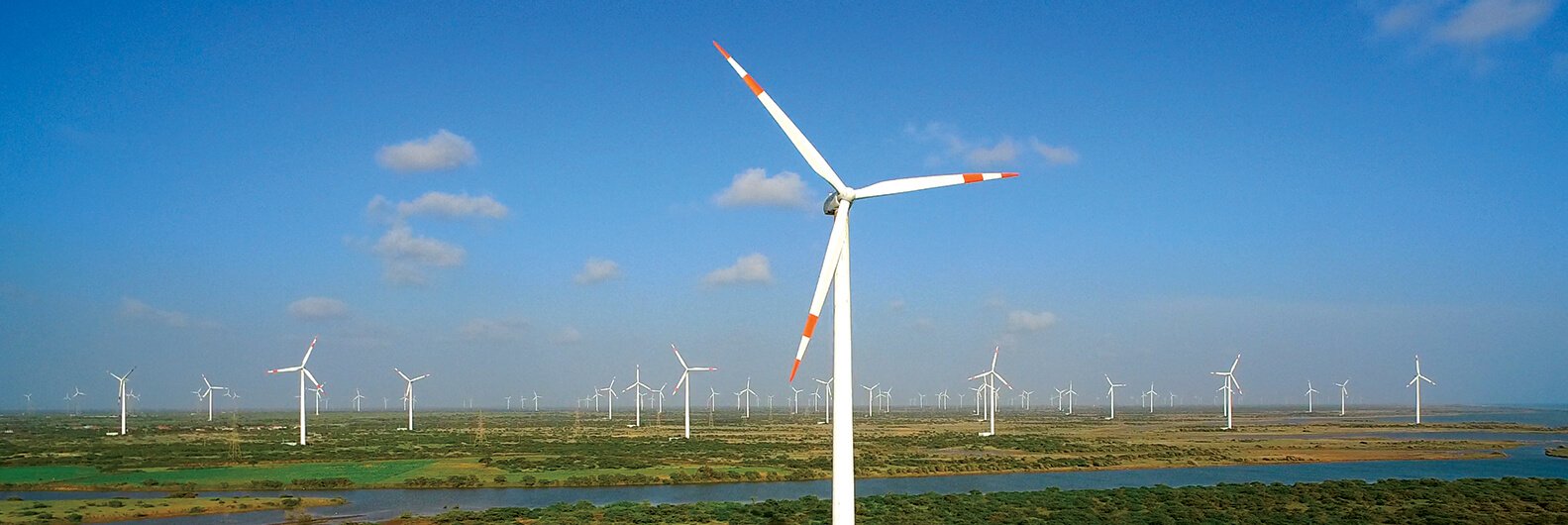
16. India’s gross wind power potential has been assessed at 695.50 GW at 120 meter above ground level. 7 States account for 651.72 GW i.e. 93.7% of the total potential – (in GW). in following manner.

17. The country currently has the fourth highest wind installed capacity in the world (39.87 GW as on 30th Sep 2021) which is about 66% of the wind capacity target of 60 GW under 175 GW RE target by 2022. The country has a manufacturing base of 10,000+ MW per annum, now suffering for want of orders, with all focus now shifting to solar energy.

18. The challenges to 140 GW level of wind energy contribution in 2030 have to be addressed in the context of only around 4.5 GW materializing in 5 years of reverse auction regime (since Feb 2017) when out of 28.1 GW bids 19.7 GW were finalized only for the highest PLF states to keep below Rs. 3 per Kwh. States like MP, Rajasthan and Maharashtra were unable to compete despite land availability. To reach a minimum 15/20 GW annual capacity addition, projects will need to be distributed all round the windy states. It is there for recommended the reverse auction scheme is replaced by the competitive bidding process, allowing tariff variations keeping in view difference in PLF (35-47%) in states. Discoms will have to be mandated to procure a stipulated percentage of wind energy in their total procurement. A close coordination with state govts will help. During evening peak between 5:00 to 8:00 PM, wind energy contributes substantial energy; there is need for introducing “time of the day” concept in net metering tariff.

19. There is need to give more importance to wind energy now, in the immediate few years ahead, allowing time for Aatma Nirbhar initiatives in annual rate of Solar Cell manufacture to pick up to meet country’s 2030 target. It is recommended the share of wind energy in 2030 target may be increased to take advantage of existing indigenous manufacturing base.

20. To give momentum to the wind energy build up, it is essential that the states are associated with regard to formulation of policies, incentives, norms and regulations from the very beginning.

21. There is also need to encourage offshore wind energy projects (2-4 GW) especially in view of higher capacity utilization factor. Nearer ports such clusters can also help in production of green Hydrogen (as in Spain) for Export.

22. The GST rate on wind turbine has been increased from 5% to 12% (1st Oct 21) which has become an additional 7% cost in the wind turbine as there is no pass through. A 5% GST should be introduced on sale of Renewable Power. This will complete the loop as currently there is no GST cost pass through.

Transportation: Hastening Electric Mobility

23. It is nice to see production & demand for Electric two wheelers picking up. Govt has floated global tender for 5400 Electric buses. Diesel / Petrol - Private cars / SUVs should attract higher taxes, to help shift to Electrics. Extensive Charging Infrastructure must be facilitated. Battery swapping concept can help reduce upfront payment by consumers. Govt has done well to introduce substantial PLI initiatives for Batteries and components. The incentives for Electrics must focus on most polluted cities.

24. It may be pointed out that support to Electric Mobility in Urban areas emanated from pollution mitigation angle. Main gains, from carbon emission angle, will result, when Electric Mobility in Highways are encouraged, with percentage of renewable contribution in power generation mix progressively increasing. MoRTH may consider some pilot projects with Trolley bus type overhead electrification of some high density Freight/Passenger high ways. Germany is considering above in some stretches in its Auto Bahn network. Sweden is experimenting stretches, which will permit charging on the run.

25. There is very strong case for progressive, planned compulsory shift of medium distance Heavy Freight on Roads to Railways. Economic Survey Budget 2019 stresses shift from Road freight to Railways to increase the share from 29% now to 45% by 2030. Railways consume only one sixth of energy compared to roads in transportation. Further, with 100% electrification of Railways and RE share in Power generation going up to 50% by 2030, there will be further reduction in carbon emissions. NITI Aayog has advocated focus on multimodal transport in India. European Union is considering higher tolls on road traffic for shift towards Railways.

Reducing Industrial Emissions: Emerging role of Hydrogen

26.  In steel sector, change in mix of inputs, e.g. increasing use of steel scrap can help in reducing carbon emission but the main problem being however its availability. Energy savings must be focused. For a Zero Carbon Emission approach however, there is need for eliminating fossil fuel in the process, by substituting with Hydrogen. (50 Kg Hydrogen required per tonne of Steel)

27. Presently cost of production of Green hydrogen (e.g. produced by Electrolysis of water, Electrolyzer supplied with Green power like Solar power) is around $5 to $6 per kg but expected to go down to 1or 2 dollars/kg with scaling up (2030). Cost of production of Grey Hydrogen (produced from use of Natural gas/ LNG or through Coal route with different degrees of carbon emission) could be three times cheaper. Removing carbon emissions from Grey hydrogen process by Carbon Capture, Storage & Utilization (CCSU) could result in Blue hydrogen classification but process comes with attendant complexities and costs.

Planning for Hydrogen Production in India

28. IOC has planned to set up a 40 MW electrolyzer at Mathura refinery and a 15 MW unit at Panipat unit & is targeting to produce 70,000 tonnes a year of green hydrogen by 2030. NTPC is experimenting small prototype electrolyzer at Simhadri and also Carbon Capture Storage from flue gases at Vindhyachal power plant to produce methane. Scaling up this methane production unit in NTPC thermal plants will help in production of large quantities methane (90% presently imported) required for the Indian industry. It can also help in petrol blending later, if ethanol production through sugarcane route is affected by water scarcity due to climate change. The main gain will be reduction of carbon emission in thermal plant substantially enabling longer use of indigenous coal. Development of small electrolyzers is also important, when hydrogen is introduced in the highways as distribution costs will be high when hydrogen is distributed from large plants, far away Coal India, GAIL etc. have also announced plans for green Hydrogen. 

29. L&T has entered into a MoU with HydrogenPro AS, a Norway-based leading Electrolyzer technology company. MoP has also brought out recently some guide lines waiving interstate transmission charges for Green Hydrogen/ Ammonia production for projects setup before 2025. Govt has announced overall plans for India to setup annual capacity of 50 MT Hydrogen with 10 MT planned for export (Japan South Korea etc.).

30. Considering financial constraints in India and the high cost of Green Hydrogen in the initial stages, production of green Hydrogen may be restricted to exports only. With 50 Kg hydrogen requirement/ tonne of steel production, Hydrogen @ 6 dollar/kg or Rs 450/Kg, Hydrogen cost will amount to Rs22,500/t of steel. This will lead to 20% increase in price.

31. The coal or biomass pathway to Hydrogen is in nascent / experimental stage and special gasification with Carbon Capture Storage & Utilization technologies will have to be developed, appropriate to end products besides Hydrogen, by use of Syn gas. Compared to green Hydrogen costing Rs500 to 600 per kg (zero emission), Steam Methane Reformation costing 200-300/ kg (emission 8.07 kg CO2 per kg of Hydrogen), Methane Cracking (new process) costing Rs200/kg (emission 1.67 kg CO2 per kg of Hydrogen), Coal pathway is estimated to cost Rs120/kg (21 kg CO2 per kg) and biomass pathway Rs120/kg (net carbon neutral).

32. The Aatma Nirbhar initiative for coal and biomass pathway will require support from Govt in a big way. A technical committee has also been formed by the Govt to go into the issue. It is recommended a PSU consortium with Coal India, NTPC, BHEL, Steel/ Fertilizer/ Chemical PSU’s with R&D support from Dept of Science & Technology & CSIR laboratories be formed to progress the issue from design/ prototype model to full scale production.

33. Bulk of the production of Hydrogen, initially, can be through the Grey route including using gas, indigenous coal and biomass. The low cost grey Hydrogen can be used for initial projects in steel cement, chemical, fertilizer and refinery sectors to reduce carbon emission in big way and help Indian industry learn & stabilize technology to keep cost down. Fossil fuels can be used to produce electricity to run electrolyzers for Green Hydrogen, enabling quick building scale of manufacture for electrolyzers thereby bringing down cost.

34. On the lines of new European Union policy initiatives (R&D for Coal & Steel, European Clean Steel Partnership with funding of Euro 1 billion by industry and Euro 700 million by EU, further funding for scaling up from R&D to production stage), there will be need for the Govt to form partnership with different PSUs/industry in initial stages. EU is also bringing a cross border adjustment tax for protection against imported steel not having gone through the green route. EU is also considering public procurement policy to provide a market for high cost green products. India needs to consider similar initiatives. India’s focus now onwards should be on costlier value added steel when using hydrogen.

35. As Power & Transportation routes have alternatives in use of RE, in initial years, Hydrogen production can be focused on the Industrial sector and heavy duty trucks on the road. Hydrogen is best used to power hard-to-electrify sectors.

Focusing on Afforestation/ Reforestation towards creation of Carbon Sinks

36. Increased funding for afforestation to create 1 BT carbon sink by 2030 will not only meet Climate Change commitment but also provide for generation of jobs in rural/ tribal areas. Funding estimates vary from Rs.60,000 Cr to 1 Lakh Cr annually. MoEF will have to establish cost on basis of site specific projects. Funding will have to be supported by raising rates for compensatory afforestation (CAMPA) fund, by carbon tax funds (cess on coal of Rs 400/T already exists) & external assistance. Availability of land will also be a major constraint. Integration with soil, water conservation and watershed improvements will be essential. To give momentum, it is important to have a participatory and incentivising approach with stake holders/ local population extending joint forestry/ social forestry concepts. State Govts support is essential.

37. In raising biomass for carbon capture, it may be ensured that the species mix, spacing and management models are in consonance with the ecology of the site, the interests of biodiversity conservation, and support to livelihoods and ecological security of local communities.

38. While Govt has given some priority to timber production in above thrust, need for focusing on biomass/ fuel wood/ pelletization etc. is advocated considering depletion of fossil fuel/coal resources. Agro-forestry, biomass production, urban forestry and concentrated forestry around environmental hot spots are specially recommended. Degraded/ waste land reclamation may be intensified.

39. It would however appear that Agro-forestry, urban tree cover & plantation coverage will not be taken as forest cover under UNFCCC interpretation. This issue will need to be pursued. National Highways (Green corridors), Railways, PSU’s, Corporates may substantially contribute to tree cover.

Addressing India’s Water Security Challenges under Climate Change

40. Out of utilizable water potential of around 700 BCMs annually, India has built/building storage to a level of 290 BCM only so far through small, medium, large storage dams. With 450 BCM storage potential, there is very urgent need, to build another 150 BCMs storage in next 15 years, to stave off water crisis due to Climate Change. The multipurpose storage dams, besides flood control and release of water for irrigation etc. also produce more hydro electric 

(green power) than Run of River (RoR) hydro plants, which will help meet peak demands. Interlinking of River projects (inter basin transfer of surplus water) have irrigation potential of 35 million hectares, 36000 MW of power.

41. Progress of Hydro projects in the past have suffered extra ordinary delays on account of agitations by foreign funded activists, Relief and Rehabilitation (R&R) issues, land acquisition problems, environmental and forest clearances, law and order issues, interstate accords for sharing of waters etc. With a liberal R&R intervention and monitoring of other issues above, there is a need to expedite Hydro projects. It is important to focus on North East Brahmaputra projects (MW) - Tawang 1(600), Tawang 2 (800), Kolai (1200), Etalin (3097), Subansiri Lower (2000), Lower Siang (2700), Dibang (2880), Demwe Lower

(1750), Naying (1000). International border projects Santosh/ Manas with Bhutan and Pancheshwar in Nepal will need to be followed up. Ground water recharge measures are also important. More desalination plants will have to be setup in coastal regions.

Reducing Agricultural emissions: Building Sustainable / Resilient Agriculture in context of climate change

42. With increasing needs of food security, increased agricultural production & livestock management brings in attendant issues of increased emissions (methane etc). The agriculture sector in the year 2016, emitted 4,07,821 Gg of CO2, which amounted to around 14% of the emissions of India for that year - Break up: 54.6% - enteric fermentation in cattle, 19.07% - agricultural soils, 17.49%- rice cultivation, 6.68%- manure management, 2.17%- burning of crop residues.

43. Improving soil health addressing distortions in NPK ratio, low carbon content in soil, proper pesticide management, promoting crops that are salinitytolerant, encouraging water conservation techniques e.g. use of micro/ drip irrigation etc., making good quality seeds affordable, developing bio-fortified cereals are important areas to be pursued.

44. There is need to introduce high yield crops, climate resilient low water requiring crops etc. There are discussions on Meat alternatives, reduced emissions from Agricultural equipment, Methane Inhibitors, Anaerobic manure processing, support to Bio Engineering etc. There is a case for setting up in a big way Bio digesters in all villages to treat manure/ agricultural residues, to reduce methane emission by 50-70%. Reducing GHG emissions from rice growing ecologies e.g. direct seeding of rice with aerobic rice varieties and alternate wetting & drying; rice cultivars with low CH4 emitting potential, midseason drainage and real-time Nitrogen management are important initiatives.

45. Half of the potential reduction could be achieved cost-effectively by efficiently utilizing fertilizers, adopting zero-tillage (propagated in USA to save fuel emission from mechanization) and managing water in rice cultivation. System of Rice Intensification (SRI) cultivation of rice leading to higher yields has been experimented successfully in Cauvery delta. Organic farming currently covers only 2.8 Mha — or two per cent of India’s net sown area of 140 Mha. Crop residue burning in North India is a serious pollution issue and needs to be tackle by incentivization for ploughing stock into soil.

46. Sustainable agriculture is far from mainstream in India, with only 5 (crop rotation; agro-forestry; rainwater harvesting; mulching and precision) Sustainable Agriculture Practices and Systems (SAPS) scaling beyond 5 per cent of the net sown area.

47. Reducing emissions in livestock through feed management - increase in quality green fodder can decrease methane production by 5 to 7%; increase in concentrate can reduce methane emission by 15–32%; increasing dietary fat content- A unit percent increase of dietary fat can reduce enteric methane emissions by 4 to 5%. Promotion of feed supplements, methane Inhibitorspotential to reduce methane production up to 50% in ruminants.

48. Climate-Resilient Agriculture (CRA) is an approach that includes sustainably using existing natural resources through crop and livestock production systems to achieve long-term higher productivity and farm incomes under climate variabilities.

49. Scaling up of Climate Resilient technologies e.g. Short duration drought tolerant cultivars of soybean (JS 9305/9560), onion (Phule Samarth), chickpea (Digvijay), Intercropping of pearl millet + moth bean (2:1) are important.

50. Bringing behavioral changes in large number of marginal farmers with low land holdings will require considerable education and motivation. Farmers will need to be incentivized for diversification of crops, adapting to new hybrids, changing practices and their income protected during transition. Performance Linked Incentives (PLI) schemes for agriculture will have to be introduced, keeping in view large no of marginal farmers. Pradhan Mantri Fasal Bima Yojna (PMFB) will need to be strengthening.

51. There is urgent need to undertake diversification of crops in the Punjab, with ground water depletion reaching alarming levels. Growing sugar cane in water scarce Maharashtra, Karnataka & Tamil Nadu are not sustainable practices A second Green Revolution will need to be introduced in the Eastern Sector, with good water availability, with focus on Rice production, Sugar cane and Ethanol production.

52. Yield can also be increased by growing short duration intermediate crops, to derive full benefit of short rainfall season in Rainfed areas. Compensation to farmers for introducing ecologically useful crops should be arranged. From a national water scarcity perspective export of water intensive rice, sugar will need to be critically analyzed; rather import of rice from neighbor countries can be examined. There is need to evolve climate smart agriculture with focus on policies derived from research conducted over longer periods. Agricultural Research must be funded substantially for developing climate resilient crops.

Contingency planning for Climate Change Impact

54. Continuous population growth negates all benefits of development efforts. Efforts must be made for stricter population control through voluntary acceptance.

UNFCCC: Financial Support from Developed Countries for Climate mitigation measures

55. India can request for large grants & soft loans with low interest rates for its Hydrogen program in this decade. India will, notwithstanding above, will have to press at the UNFCCC for more time for peaking carbon emissions (beyond 2040 but within 2070 target) and demand developed countries to reduce carbon emission in a big way and at faster pace. IPCC Report 2022 urges global emission peaking by 2025, reduction in carbon emission by 43% by 2030 and reduction of methane emission by one third. The developed countries have to contribute in a substantial way.

56. There is need to estimate India’s fund requirements in stages up to 2070. CEEW paper estimates overall requirement of 10.1Trillion dollars from 2020 up to 2070, i.e. annually 200 Billion dollars (Rs15 lakh cr). This is based on a scenario of carbon peaking by 2040/zero emission by 2070. The Power mix for 2070 is based on 7,753 (GW) :-

Hydrogen production will progressively rise to 134 MT by2070. Standard Chartered Bank UK recent report on India’s Climate finance mentions 12.4 Trillion dollar requirement up to 2070.

57. In the background of Govts annual capital funds are of the order of Rs 7.5 lakh Cr only it is advisable that the limited climate resources are focused on reaching level of 500 GW RE, making beginning on both Green & Grey Hydrogen (coal / biomass) production, support experimental hydrogen interventions in industrial sectors-Steel, Cement, Fertilizer, chemicals, Refineries, support carbon emission reduction in coal based generation and afforestation for 2030.

58. Presently funds for Climate Change mitigation measures (8 pillars) are being made within annual Budget but progress has been slow. There is need for separate funding for Climate Change initiatives through non lapsable funds. Raising resources through imposition of carbon tax (green taxonomy) has been planned in developed countries and India will have to introduce carbon taxation (rationalizing adhoc interventions like cess on coal) and carbon pricing (cap & trade) in harmony with international practice.

59. Govt may prescribe minimum lending percentage for green finance and regulators announce guide lines. Allowing Corporates to invest on Climate Change themes, allied to their business with tax breaks (with regulatory oversight) may be one efficient route. Payments to ESG funds, Green bonds by retail investors may be considered for some tax relief. ESG aligned MNC’s may be invited to invest in Indian initiatives.

Key Macro Recommendation

60. There is urgent need for setting up a high level Climate Change mitigation authority to monitor Climate Initiatives 24x7. Close involvement of State Govts is essential.

61. There is need for the Department of Science & Technology and CSIR institutions to earmark some of their existing resources to Climate Change/ R&D initiatives – Clean Coal / CCSU technologies, Hydrogen development especially through the Coal and Biomass route, Reduction in carbon emissions in thermal, steel, cement, refineries, fertilizers etc. Fertilizer & Chemicals through Coal route should also be focused. Coal India, NTPC and other central PSU’s in different industrial sectors must join in these efforts for building prototypes and commercialization.

62. India should strive to progressively intensify more on knowledge building initiatives, R&D etc. so that this not only enables the GDP to rise at a faster pace but also help in reducing carbon intensity in our GDP. India needs to transit towards knowledge economy faster.

63. Message of PM at COP26 for adapting one’s Life style changes in harmony with Environment will need to be spread countrywide. It is important for individuals to reduce their needs and wants and consumption levels.